Diagnostic Enzyme Procurement Checklist for IVD Reagent Plants
For a diagnostic reagent manufacturer, enzyme procurement is not a spot buy. It is a controlled supply decision that affects QC release, lot-to-lot performance, documentation workload, and finished-kit continuity.
Vitreline supports IVD reagent manufacturers that need a bulk enzyme supplier for diagnostic reagent manufacturing with disciplined lot control, clear documentation, and procurement-aware communication.
Use this checklist to qualify enzyme supply for scale-up, replenishment, and long-term reagent production.
1. Confirm fit with your reagent architecture
Before price comparison, confirm that the enzyme is compatible with the way your reagent is formulated, filled, stored, and released.
Evaluate:
- Compatibility with your buffer system and stabilizer package
- Performance after exposure to your filling and hold conditions
- Behavior in liquid, lyophilized, or dry-blended reagent formats
- Tolerance to preservatives, salts, surfactants, and excipients in your matrix
- Stability profile across your intended shelf-life model
- Suitability for pilot, validation, and commercial batch sizes
A qualified supplier should understand that enzyme performance is matrix-dependent. A material that looks acceptable in isolation can behave differently inside a finished reagent.
2. Require lot-to-lot consistency evidence
Lot consistency is central to diagnostic reagent manufacturing. Procurement should request evidence that the supplier controls variation before material reaches your QC team.
Ask for:
- Lot history for comparable bulk supply
- Defined release specifications
- COA format review before purchase
- Retention sample policy
- Trend visibility across critical quality attributes
- Clear escalation paths for deviations
Consistency reduces investigation time. It also protects validated formulations from avoidable drift.
3. Review documentation before qualification
Documentation gaps create delays during supplier qualification, internal approval, and regulatory file maintenance. Request the document set early.
Typical documentation may include:
- Certificate of Analysis
- Safety Data Sheet
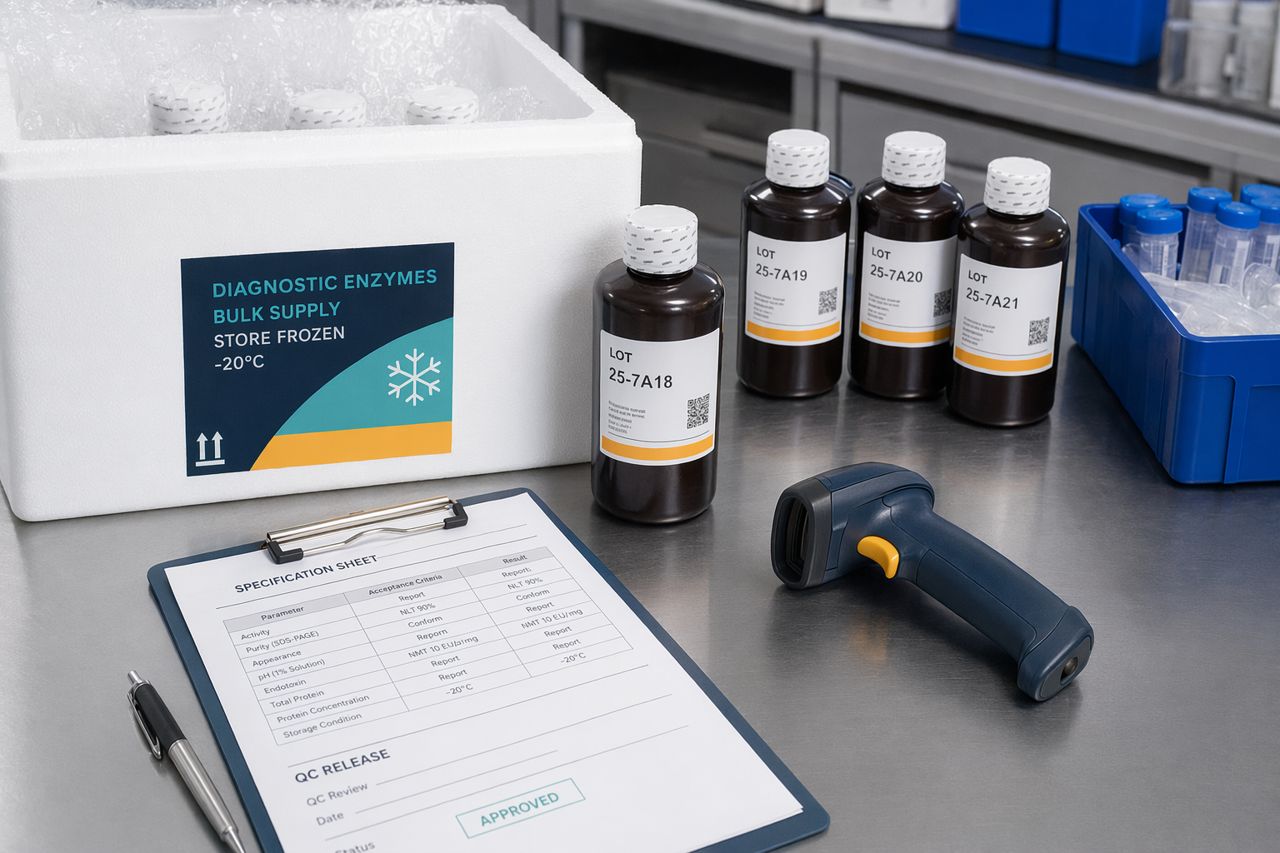
- Product specification sheet
- Origin and manufacturing statement where applicable
- Allergen, animal-origin, or relevant risk statements where applicable
- Change-control policy
- Shelf-life and storage guidance
- Packaging and labeling information
- Quality questionnaire support
Vitreline structures enzyme supply around clean handoff to procurement, QA, and technical teams.
4. Verify bulk packaging and handling alignment
Packaging can affect usability at the plant level. The right bulk format helps receiving, sampling, dispensing, and inventory control.
Check:
- Container size options for pilot and production lots
- Closure integrity and tamper-evident requirements
- Label information needed by your receiving team
- Temperature-controlled shipping needs
- Batch traceability from shipment to internal lot assignment
- Handling instructions for thaw, mix, aliquot, or reclose steps where relevant
Bulk supply should reduce operational friction, not create new handling risk.
5. Assess lead times and forecast support
Diagnostic reagent plants need continuity. A technically acceptable enzyme is not sufficient if supply timing is unpredictable.
Confirm:
- Standard lead-time range for routine orders
- Planning requirements for larger campaigns
- Safety-stock or reserved-lot options
- Forecast communication cadence
- Minimum order expectations
- Expedited supply feasibility
- Regional shipping considerations
Procurement teams should know when to order, what can be reserved, and how the supplier communicates risk.
6. Clarify change-control expectations
Uncontrolled supplier changes can create expensive downstream work. Your enzyme supplier should define how changes are reviewed and communicated.
Ask about notification for changes involving:
- Manufacturing site or process
- Raw material source
- Specification or release criteria
- Packaging configuration
- Storage recommendation
- Documentation format
- Discontinuation or replacement material
Change-control support helps maintain validated reagent performance and internal quality records.
7. Align technical support with plant realities
Support should be practical. Diagnostic reagent manufacturers need fast, specific answers that help them make supply decisions.
Useful supplier support includes:
- Compatibility discussion for the intended reagent matrix
- Guidance on pilot-to-production scale transition
- Review of stability and handling constraints
- Support during incoming QC questions
- Document clarification for supplier qualification
- Root-cause communication if an issue is detected
The goal is not generic technical literature. The goal is material that fits your manufacturing process and release workflow.
8. Compare total procurement value, not only unit price
Low purchase price can become expensive if it increases QC burden, deviation handling, reformulation work, or inventory risk.
When comparing suppliers, include:
- Lot acceptance rate
- Documentation completeness
- Forecast reliability
- Communication speed
- Change-control discipline
- Packaging fit
- Reorder consistency
- Technical responsiveness
A stable supplier relationship protects production schedules and reduces hidden cost.
Quick checklist for supplier qualification
Use this list during RFQ review:
- Enzyme fits the intended reagent matrix
- Bulk format supports pilot and production needs
- COA and specification format are acceptable
- Lot traceability is clear
- Shelf-life and storage guidance are documented
- Retention sample policy is available
- Lead times match production planning
- Change-control process is defined
- Quality questionnaire support is available
- Technical contact is available for compatibility questions
- Commercial contact understands forecasts and repeat supply
Why diagnostic reagent manufacturers choose Vitreline
Vitreline supplies bulk enzymes for diagnostic reagent manufacturing with a focus on controlled sourcing, documentation readiness, and production continuity.
We support teams that need:
- Bulk enzyme supply for IVD reagent production
- Lot-to-lot consistency for controlled manufacturing
- Documentation for procurement, QA, and supplier qualification
- Practical lead-time planning
- Change-control communication
- Compatibility discussion for reagent development and scale-up
- Responsive support from first RFQ through repeat supply
Request a quote
If you are qualifying an enzyme for diagnostic reagent manufacturing, send your target enzyme, intended reagent format, annual volume estimate, documentation needs, and timeline.
Vitreline request a quote form
Our team will review fit, supply options, documentation availability, and next steps for qualification.