How Diagnostic Reagent Manufacturers Review COAs for Enzyme Ingredients
For diagnostic reagent manufacturers, a certificate of analysis is not a formality. It is part of the lot release package that connects supplier qualification, incoming QC, formulation risk, and finished reagent performance.
When enzymes are sourced in bulk, the COA must support more than receipt inspection. It should help procurement, quality, manufacturing, and technical teams answer the same question: can this lot move into controlled production without creating avoidable assay, documentation, or change-control risk?
Vitreline supports diagnostic reagent manufacturers that need a bulk enzyme supplier for diagnostic reagent manufacturing with consistent lots, clear documentation, and procurement-ready communication.
Why COA review matters for enzyme ingredients
Enzymes are functional raw materials. Small differences in lot history, handling, formulation compatibility, or release documentation can affect downstream reagent behavior.
A strong COA review process helps teams:
- Confirm the lot received matches the purchase order and supplier commitment.
- Verify that released characteristics align with internal specifications.
- Check traceability from supplier lot to internal material code.
- Identify documentation gaps before the lot reaches production.
- Maintain audit-ready evidence for supplier qualification and internal approval.
- Reduce delays caused by incomplete, inconsistent, or unclear records.
The goal is not to duplicate the supplier's release process. The goal is to decide whether the supplied documentation is complete, consistent, and aligned with the manufacturer's approved requirements.
Start with document control, not the data table
A COA should first be reviewed as a controlled document. Before technical values are assessed, confirm that the document itself is usable in a regulated manufacturing workflow.
Initial document checks
Review the COA for:
- Supplier name and address.
- Product name and catalog or material identifier.
- Supplier lot or batch number.
- Manufacturing date, release date, and retest or expiry date where applicable.
- Document version, issue date, or revision status.
- Authorized quality signature or electronic release indicator.
- Clear reference to storage and shipment conditions.
- Page numbering and complete attachments, if included.
If the document cannot be tied clearly to the material in hand, the lot should be held for clarification before internal release routing continues.
Match the COA to the purchase and receipt records
COA review should connect directly to procurement and receiving records. This avoids downstream ambiguity when the same enzyme is supplied in multiple pack sizes, concentrations, buffers, or formats.
Records to reconcile
Compare the COA against:
- Purchase order line item.
- Supplier order confirmation.
- Packing list.
- Receiving inspection record.
- Internal material master.
- Approved supplier list entry.
- Any active quality or supply agreement.
The lot number on the container label, packing documentation, and COA must match. Any mismatch should trigger a controlled hold and supplier clarification.
Review acceptance criteria against internal specifications
The COA is most useful when it is reviewed against the manufacturer's own approved raw material specification. Supplier release criteria and internal acceptance criteria may not be identical.
A practical review compares each reported attribute to the controlled internal requirement and records the disposition.
Common COA attributes for diagnostic enzyme ingredients
Depending on the enzyme and intended reagent system, the COA may include:
- Identity confirmation.
- Appearance or physical form.
- Protein concentration or formulation concentration.
- Purity profile or impurity limits.
- Functional release result.
- Buffer composition or formulation description.
- pH range.
- Preservative or stabilizer information.
- Bioburden or microbial control statement, where relevant.
- Endotoxin or nucleic acid-related controls, where required by the application.
- Residual host-cell or process-related impurity statements, where applicable.
- Storage conditions.
- Retest or expiry dating.
Internal teams should avoid relying only on a pass statement. The review should confirm that the reported attributes are the attributes required for the finished diagnostic reagent process.
Confirm assay compatibility without exposing proprietary methods
Diagnostic manufacturers often protect assay design, formulation know-how, and QC release logic. COA review does not require confidential methods to be shared externally.
Instead, the manufacturer can define supplier-facing requirements in controlled terms:
- Required enzyme grade or intended manufacturing use.
- Compatible buffer and stabilizer constraints.
- Acceptable preservative profile.
- Expected storage condition and shipment condition.
- Required documentation set per lot.
- Notification expectations for material, site, process, or specification changes.
This allows supplier qualification to stay precise without disclosing internal assay architecture.
Check traceability across lot records
Traceability is more than a lot number. For diagnostic reagent manufacturing, traceability supports complaint investigation, nonconformance handling, and change-impact review.
Traceability questions to ask
- Can the supplier lot be linked to the manufacturing record?
- Is the released lot clearly connected to the packaging configuration received?
- Are sub-lots, blends, or repackaging steps identified where relevant?
- Is the COA consistent with prior lots supplied under the same product code?
- Are storage and shipment conditions documented in a way your quality system can retain?
- Is the documentation sufficient for incoming QC and internal lot disposition?
If the lot will be used across multiple reagent batches, internal traceability should also connect supplier lot consumption to each finished reagent batch record.
Evaluate lot-to-lot consistency
A single COA can confirm release status. A trend review shows whether the supply is stable enough for routine production.
Diagnostic reagent manufacturers commonly track selected COA attributes over multiple lots. The purpose is to detect drift, variability, or supplier-side process changes before they affect internal manufacturing.
Useful trend-review practices
- Compare the current lot to recent approved lots.
- Flag changes in formulation description, buffer, stabilizer, or preservative.
- Review dating patterns and remaining shelf life at receipt.
- Monitor shipment condition compliance.
- Record deviations and supplier explanations in the raw material file.
- Route unusual results to technical and quality reviewers before release.
Trend review is especially important when enzymes are used in high-volume reagent production, automated fill-finish environments, or assays with narrow formulation tolerance.
Define a clear internal approval route
COA review works best when each function knows its decision point.
Typical approval routing
Receiving or warehouse team
Confirms material identity, container condition, label match, temperature indicator status if used, and documentation presence.
Quality control or incoming quality
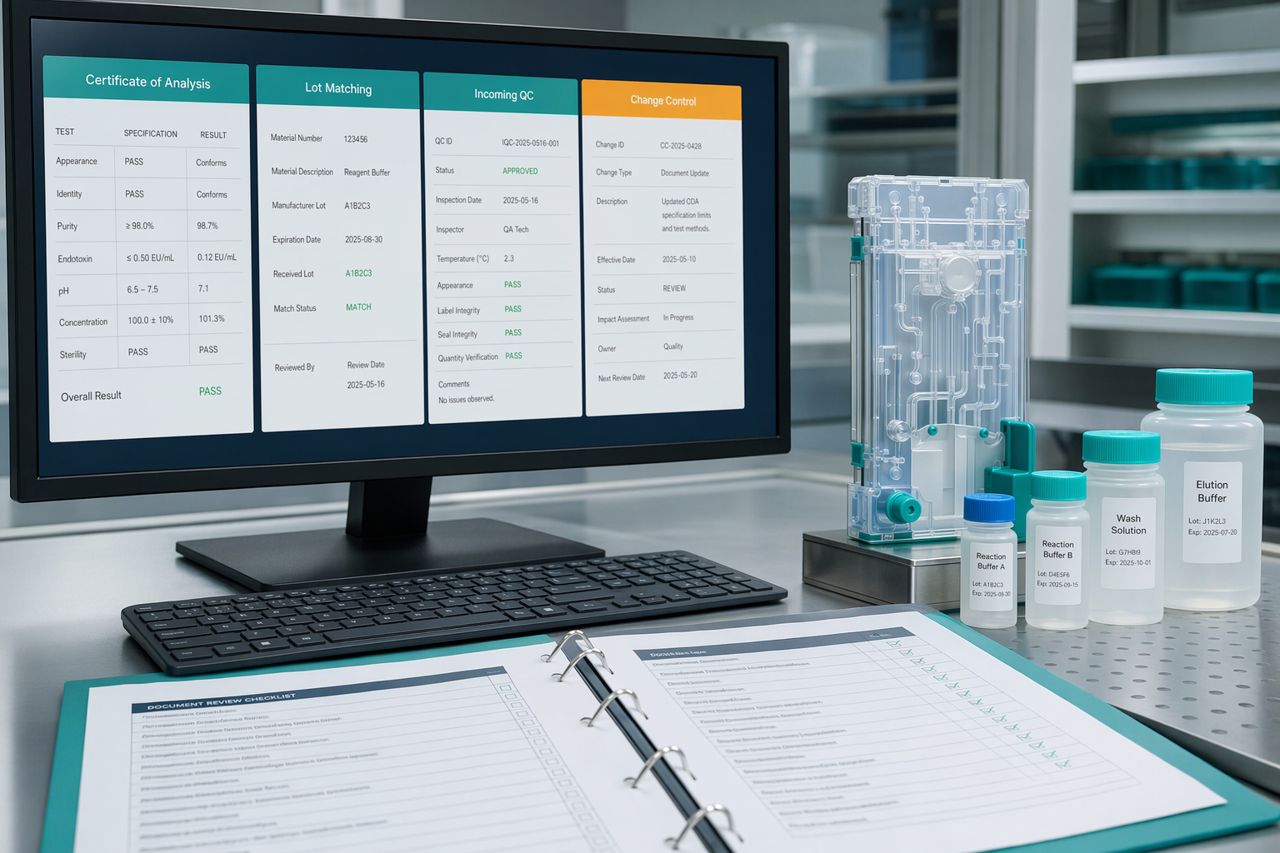
Reviews COA completeness, compares reported attributes with internal specifications, assigns pass, hold, or reject status, and records the disposition.
Technical or assay development team
Reviews compatibility concerns, formulation changes, or historical lot behavior when needed.
Quality assurance
Approves exceptions, supplier clarification records, deviation handling, and final material release where required by the quality system.
Procurement or supplier management
Tracks supplier responsiveness, documentation quality, lead times, and recurring issues that may affect qualification status.
This structure prevents technical questions from being treated as purchasing issues and prevents documentation gaps from reaching production.
Manage exceptions before production release
Not every COA discrepancy means the enzyme lot is unusable. But every discrepancy should be controlled.
Examples that may require supplier clarification include:
- Missing signature or release authorization.
- Lot number mismatch between label and COA.
- Unclear expiry or retest dating.
- Missing storage condition statement.
- Changed formulation wording versus prior lots.
- A reported attribute absent from the internal specification cross-check.
- A document revision that has not been assessed internally.
The material should remain in controlled status until the issue is resolved, documented, and approved under the manufacturer's quality system.
Include change-control expectations in supplier qualification
COA review can reveal a change after it has already happened. Supplier qualification should reduce that risk by defining notification expectations in advance.
For enzyme ingredients used in diagnostic reagent manufacturing, change-control expectations may cover:
- Manufacturing site changes.
- Process or purification changes.
- Raw material or component changes that affect the enzyme formulation.
- Specification or release-document changes.
- Packaging, container, or closure changes.
- Storage, shipment, or shelf-life changes.
- Product discontinuation or supply interruption risk.
Procurement and quality teams should agree on which changes require prior notification, technical review, or requalification before routine purchasing continues.
Build a COA review checklist
A controlled checklist helps make review consistent across buyers, QC reviewers, and product families.
Suggested checklist sections
- Document identification: COA number, version, issue date, authorized release.
- Material match: product name, supplier code, internal code, lot number, pack size.
- Receipt match: PO, packing list, label, quantity, container condition.
- Specification comparison: required attributes, reported results, internal disposition.
- Storage and dating: storage condition, shipment condition, retest or expiry status.
- Traceability: supplier lot record, internal lot record, batch usage plan.
- Change review: formulation wording, release criteria, documentation changes, supplier notices.
- Approval route: reviewer, approver, date, disposition, exception record if needed.
The checklist does not need to expose proprietary assay methods. It needs to show that the lot was reviewed against controlled manufacturing requirements.
What to ask an enzyme supplier before the next order
A supplier that understands diagnostic reagent manufacturing should be able to support documentation needs before the purchase order is placed.
Ask whether the supplier can provide:
- Lot-specific COA with controlled release status.
- Consistent product identification across quote, order, label, and COA.
- Advance visibility on lead time and available batch sizes.
- Lot reservation or forecast support for planned manufacturing.
- Documentation aligned with incoming QC and supplier qualification needs.
- Clear notification process for material or documentation changes.
- Technical communication for formulation and assay compatibility questions.
This is where procurement value becomes measurable. The right supplier reduces avoidable review cycles, holds, and clarification loops.
Vitreline's approach to bulk enzyme supply
Vitreline supplies enzyme ingredients for diagnostic reagent manufacturers that require controlled documentation, lot consistency, and practical supplier communication.
Our support is built around the realities of IVD reagent manufacturing:
- Bulk supply planning for recurring production.
- Lot documentation suitable for internal review.
- Clear traceability from quote to shipment.
- Procurement-aware communication on lead times and availability.
- Support for supplier qualification and change-control expectations.
- Technical discussion focused on assay compatibility without requiring disclosure of proprietary methods.
If your team is reviewing enzyme ingredient COAs, qualifying a new supply source, or planning a larger bulk requirement, Vitreline can help define the documentation and supply expectations before the order is placed.
Request a quote
Share your enzyme target, intended diagnostic reagent use, estimated volume, documentation expectations, and preferred lead time. Vitreline will review fit, available supply options, and the lot documentation package required for your internal approval process.