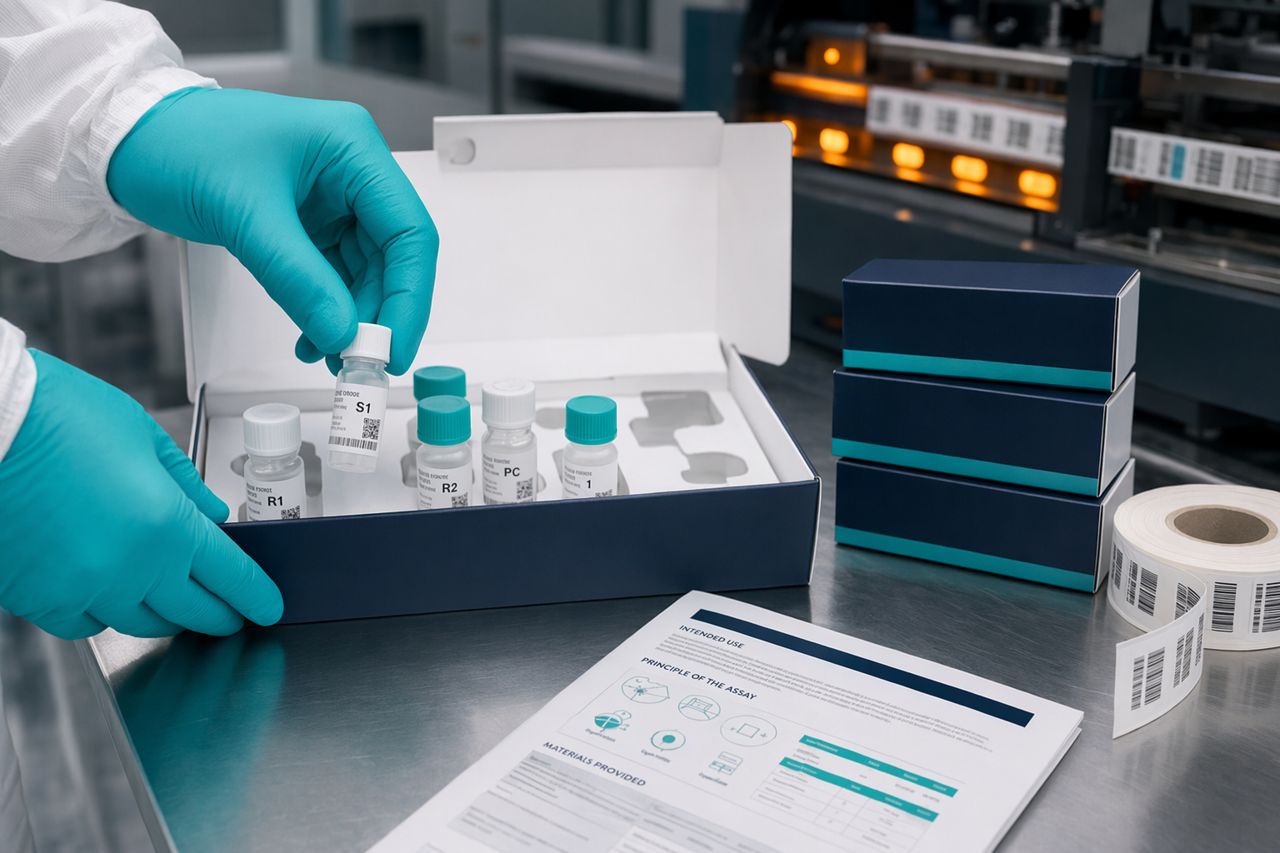
Packaging, Labeling, and Insert Coordination for Diagnostic Kit Manufacturers
Diagnostic kit manufacturing is not only a formulation workflow. It is a coordination workflow.
A kit batch may depend on enzyme lots, buffers, filled components, primary packaging, labels, inserts, cartons, barcode data, and release documentation. If one element changes late, the whole batch can slow down. The result is often rework, label reconciliation, delayed batch records, or a missed shipment window.
For diagnostic reagent manufacturers, procurement decisions made upstream can affect downstream packaging control. This is especially true for enzyme raw materials, where lot documentation, change notifications, availability, and pack configuration can influence how quickly a kit moves from incoming QC to final release.
Vitreline supplies bulk enzymes for diagnostic reagent manufacturing with the documentation and communication discipline expected by IVD production teams, purchasing groups, and supplier qualification managers.
Why packaging coordination starts with raw material procurement
Packaging is usually treated as a final manufacturing step. In practice, it begins much earlier.
A kit label may reference component identity, storage condition, expiry structure, lot traceability, catalog configuration, or instructions for use. Inserts may be version-controlled against the formulation, validated claims, component presentation, and stability data. Batch release may require alignment between raw material records and finished kit documentation.
When raw materials arrive late, arrive with incomplete documentation, or require unplanned substitutions, packaging teams inherit the disruption.
Typical downstream effects include:
- Label holds while lot numbers or component references are confirmed.
- Insert review delays when component specifications change.
- Batch record updates after procurement substitutions.
- Reconciliation work across primary labels, secondary labels, cartons, and inserts.
- Additional quality review before finished kit release.
- Shipment delays caused by missing supplier documentation.
The cost is not only operational. It can affect customer delivery commitments and procurement confidence.
Enzyme lots influence more than formulation
Enzymes are functional raw materials. They are also controlled procurement items.
For diagnostic reagent manufacturers, enzyme supply can affect multiple manufacturing records and release gates. A new lot may require incoming evaluation. A new source may require supplier qualification. A change in specification, packaging format, origin statement, or documentation structure may trigger internal review.
That means enzyme procurement should be coordinated with packaging planning, not handled in isolation.
Key questions include:
- Will the enzyme lot be assigned before label artwork is locked?
- Is the certificate of analysis available in the format quality needs?
- Are storage and handling conditions aligned with kit labeling?
- Is the bulk pack configuration compatible with internal dispensing and aliquoting?
- Are change notifications available early enough for insert review?
- Can future lots be planned around forecasted kit builds?
A bulk enzyme supplier for diagnostic reagent manufacturing should understand these dependencies.
Labeling risk: late data, wrong assumptions, slow release
Labels are small, but the control burden is significant.
Primary containers, kit boxes, outer shippers, and internal component labels may all need traceable data. Lot numbers, storage statements, component names, and expiry logic must match the controlled batch record. When an enzyme is supplied in a way that creates uncertainty, labeling becomes harder to close.
Common pain points include:
- Incomplete supplier paperwork at goods receipt.
- Inconsistent lot naming across packing lists and technical documents.
- Unclear shelf-life or retest language.
- Packaging descriptions that do not match what manufacturing receives.
- Unplanned lot changes after label generation.
These issues do not always stop production immediately. They often surface at review, reconciliation, or release. By then, the cost of correction is higher.
Vitreline supports procurement teams by keeping enzyme lots traceable, documentation aligned, and supply communication clear before production decisions are locked.
Insert coordination: technical language must stay synchronized
Instructions for use and kit inserts carry controlled technical content. They may describe storage, handling, component preparation, limitations, stability, and performance-related context.
If a raw material change affects how a component is described or controlled, the insert review cycle may need to reopen. For manufacturers running multiple kit formats or regional variants, this can multiply quickly.
Procurement can reduce this risk by selecting enzyme suppliers that support stable specifications, predictable lot planning, and documented change-control communication.
For kit manufacturers, the goal is not only to buy the enzyme. The goal is to protect the validated presentation of the finished reagent system.
Packaging formats should fit the manufacturing line
Bulk enzyme supply should support how a diagnostic reagent manufacturer actually produces kits.
A production team may need bulk containers for internal formulation, smaller controlled packs for staged manufacturing, or lot-reserved supply for repeated builds. The wrong pack format can create avoidable handling steps, extra freeze-thaw planning, material reconciliation work, or open-container risk.
Procurement should evaluate enzyme supply against production realities:
- Bulk fill volumes aligned with batch size.
- Container formats compatible with controlled thaw and dispense processes.
- Clear labeling on supplier packaging.
- Consistent documentation across containers from the same lot.
- Practical lead times for scheduled manufacturing campaigns.
- Supply planning that supports repeat kit builds.
The packaging team benefits when upstream material presentation is predictable.
Documentation is part of the material
In diagnostic reagent manufacturing, an enzyme shipment is not complete because a container arrived. It is complete when the material and documentation can move through quality review.
Documentation requirements may include certificates of analysis, safety documentation, origin and compliance statements, storage declarations, shelf-life or retest information, and change-control records. The exact package depends on the manufacturer’s quality system and market requirements.
For procurement, the important point is simple: documentation availability affects batch timing.
A missing document can hold a material in quarantine. A mismatched document can trigger investigation. A delayed clarification can push packaging and release dates.
Vitreline works with diagnostic reagent manufacturers that need supplier documentation to be usable by purchasing, quality, regulatory, and production teams.
Change control should be visible before packaging lock
Packaging artwork and inserts are often locked before the finished batch is ready to ship. That creates a timing risk.
If an enzyme supplier introduces a change after packaging content is approved, the manufacturer may need to assess whether labels, inserts, specifications, or batch records are affected. Even when no technical update is required, quality teams still need evidence.
Strong supplier communication helps reduce surprises.
Procurement teams should look for:
- Defined change-notification expectations.
- Clear escalation contacts.
- Consistent lot documentation.
- Forecast visibility for future manufacturing campaigns.
- Support during supplier qualification and periodic review.
Change control is not an administrative extra. It is part of supply continuity.
Procurement checklist for kit packaging alignment
Before locking packaging or insert timelines, diagnostic kit manufacturers should confirm the following with enzyme suppliers:
- The lot strategy supports the intended production batch.
- Documentation will be available before incoming quality review.
- Storage statements are consistent with internal labels and records.
- Pack sizes are practical for formulation and dispensing workflows.
- Lead times match kit build and packaging schedules.
- Future lot availability is understood for repeat manufacturing.
- Change-control communication is defined.
- Supplier qualification files are current and complete.
- Quality contacts are identified before issues arise.
- Procurement has a route to reserve or plan bulk supply.
This checklist is not theoretical. It reduces rework.
Where Vitreline fits
Vitreline supplies bulk enzymes for diagnostic reagent manufacturers that need controlled sourcing, clear documentation, lot consistency, and procurement-ready communication.
Our role is to support the raw material side of the kit manufacturing timeline so your team can coordinate formulation, packaging, labeling, insert control, and release with fewer surprises.
We focus on practical B2B supply requirements:
- Bulk enzyme supply for diagnostic reagent production.
- Lot-to-lot consistency support.
- Assay compatibility discussions during sourcing.
- Documentation for supplier qualification and incoming review.
- Lead-time planning for scheduled manufacturing.
- Change-control support for controlled production environments.
- Commercial communication that works for procurement and quality teams.
Request a quote for bulk enzyme supply
If your diagnostic kit program depends on stable enzyme supply, involve procurement early. Share the enzyme target, intended kit format, documentation needs, expected lot timing, and bulk quantity range.
Vitreline request a quote for bulk enzyme supply aligned with diagnostic reagent manufacturing, packaging coordination, and batch release planning.