Bulk glucose oxidase is offered as a powder at 300 to 10000 U/g, with the odd liquid at 12000 U/mL, labelled for food or feed use, packed in 1 kg bags and 25 kg drums, with a shelf life of 12 months and storage at 4-25 C in a dry sealed pack. Nothing in that offer is written for an assay, so the reagent buyer's job is to make a bulk offer answer reagent questions before the first kilogram is ordered. The people who choose this enzyme for a living weigh price against the stability of enzyme quality and the service behind it, and that three-point checklist transfers straight to a reagent line. The guides on picking a maker come back to the same two worries every time: lot consistency and how the activity is labelled. Suppliers fall into three kinds, large producers, trading houses and lab-chemical houses, with bulk material in 25 kg packs at one end and purified lab material sold by the small unit at the other, and no tier in between that is made for reagent work. This page is for the procurement or R&D lead at a kit maker or reagent blender who is sourcing a trial quantity for scale-up.
Ask for a spec sheet and a trial sample once you know your reagent format and the activity you need per litre of working reagent.
The unit trap: U/mg, U/g and U/mL are three different offers
One lysozyme offer in the same enzyme category is labelled 2000 U/mg and sold as a 1 kg bag with a minimum order of 1 bag. Another lysozyme offer lists 2,000,000 U/g, labelled for food use and extracted from egg white. A third, sold for animal feed, lists 1,000,000 U/g as a solid powder. A unit per milligram is a thousand units per gram, so 2000 U/mg and 2,000,000 U/g are the same strength written two ways, and a buyer who skips the conversion reads one offer as a thousand times stronger than the other. Glucose oxidase has the same spread: the bulk powders run from 300 to 10000 U/g, and a liquid quoted at 12000 U/mL cannot be compared with a powder until the density and the dilution behind it are known. Most buyers of the bulk powder settle on the 10000 U/g grade. Even a teaching lab slips on the unit: under a glucose-by-glucose-oxidase method video, a comment asks whether the reagent step at 3:55 is 5 mcl or 5 ml, because the voice and the on-screen text disagree. Another comment under the same video asks the question a reagent blender should put to a supplier first: "what is the activity of glucose oxidase and peroxidase in the final reagent?"
What a bulk offer shows, and what a reagent line has to ask instead
Read the offer line by line and write the reagent question next to each one before any sample ships.
| Offer line | What a bulk offer typically shows | What to ask the supplier |
|---|---|---|
| Activity | 300 to 10000 U/g for powders, 12000 U/mL for a liquid | the assay method, substrate, temperature and pH the unit was measured at |
| Activity unit | 2000 U/mg on one offer, 2,000,000 U/g on another, for the same enzyme | one unit basis, converted by the supplier, printed on the spec sheet |
| Form | solid powder, stated outright on the feed offer | moisture or solids content, and whether a liquid carries a stabiliser |
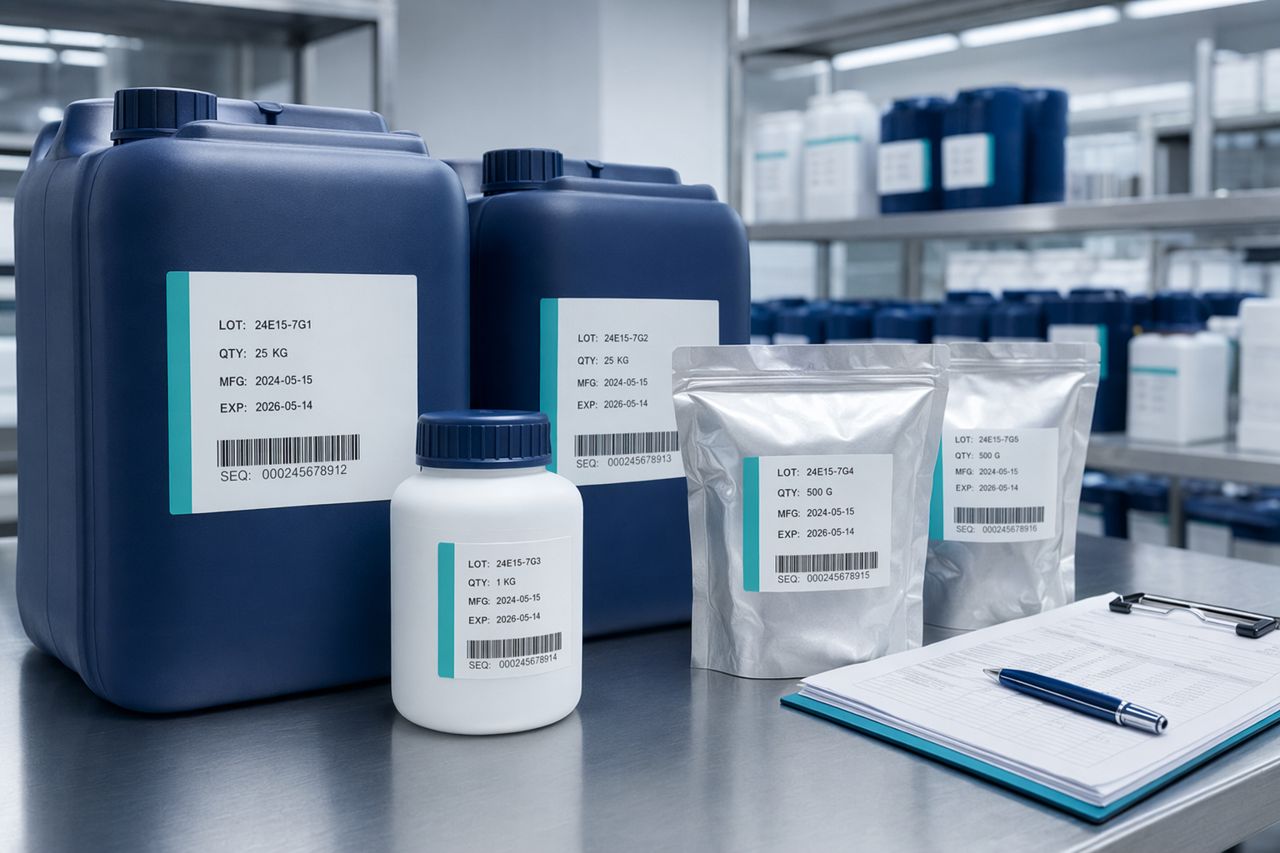
| Pack | 1 kg bags for trial quantities, 25 kg drums for bulk | a 1 kg trial pack drawn from the same lot as the 25 kg you would scale to |
| Grade label | "refined", "food use" or "feed use", a label and nothing more | the test behind the label: purity method, protein content, interfering side activities |
| Shelf life | 12 months | the activity retained at 12 months and the storage temperature that figure assumes |
| Storage | 4-25 C, dry, in the original sealed pack | the shipping temperature for the trial pack and what changes after opening |
| pH window | 3.0-7.0 on some offers, a narrower 5.5-6.5 on others | the pH at which the activity figure was measured, because your reagent buffer will differ |
| Lot record | a minimum order of 1 bag, and nothing about the lot | lot number, lot-to-lot activity spread, and the acceptance range on the spec |
Grade labels are not test methods
The "refined" label on the 2000 U/mg offer is a word the seller chose, and it says nothing about how the activity was measured. The feed offer is a solid for livestock use, carrying the same enzyme name a reagent buyer would type into a search box. The sellers who write the buyer guides know this, which is why their advice is to judge a maker on the stability of enzyme quality and on service, not on the label. The gap is the problem: the bulk label tells you the enzyme was made for dough or feed, and a lot has to be requalified on your own assay no matter what the label says. A raw-material house that serves kit makers shows its quality control as size-exclusion chromatography, mass spectrometry, gel electrophoresis and integrity analysis, and ships lyophilised to cut cost and delivery time. A reagent manufacturer explains that diagnostic reagents are made in cleanrooms and that short shelf-life products need their own handling. Ask a bulk seller for the same list of methods, and the answer tells you whether the lot can be qualified or should stay in the bakery.
Every new lot gets a control run
Reagent dosing on a production line is time-pressure dispensing of small volumes, so a small shift in enzyme activity per millilitre becomes a large shift in what lands in the well. Run a control with every new lot, log the result next to the lot number, and treat a jump between lots as a specification failure rather than noise.
Pairing activities: peroxidase in the reagent, catalase in the drum
The glucose oxidase step produces gluconic acid and hydrogen peroxide; the peroxide then drives a peroxidase and a chromogen to a colour, so the reagent's result depends on two enzyme activities, not one. Buyers of the bulk powder already pair it, but the other way round: catalase is the most common companion in their orders, with lipase and a fungal alpha-amylase some way behind. Catalase exists in those orders to remove the peroxide, which is the opposite of what a colour reagent wants, so a lot made for a market that buys catalase alongside may carry catalase as a side activity that the spec never mentions. None of those buyers states an assay application; the material is being qualified by its buyers for bakery and feed work, not sold as reagent stock.
Selection and troubleshooting list
- Convert every activity to one basis before comparing anything: 2000 U/mg and 2,000,000 U/g are one strength, not two.
- Ask for the assay behind the unit, because the guides for picking a maker put activity labelling next to lot consistency as the two things that go wrong.
- Refuse a liquid-against-powder comparison until density and solids are on paper: 12000 U/mL and 10000 U/g are not the same column.
- Demand the lot number and the lot-to-lot spread, because a bulk offer carries a minimum order of 1 bag and nothing about the lot.
- Write peroxidase activity and catalase side activity into the spec, because the reagent needs the first and the bulk market ships the second alongside as the usual companion order.
- Order the trial pack from the lot you will scale to: 1 kg bags are the trial size and 25 kg drums are the bulk tier.
- Write the storage into the purchase order, 4-25 C and dry in the sealed pack, and ask what the 12 months of shelf life mean in retained activity.
- Re-check the activity per millilitre after any lot change on a line that dispenses by time and pressure, because the dispensed volume will not forgive it.
- Weigh stability and service next to price, the way the buyers who live on this enzyme already do.
Common mistakes we see in reagent sourcing
The first mistake is to treat a grade word as a test result, when the word is a label the seller chose. The second is to read a bulk offer in 25 kg packs as a bigger version of the purified lab material, when the two sit in separate supplier tiers with nothing between them. The third is to specify the glucose oxidase alone and leave the peroxidase activity unstated, the gap that the comment under the method video exposes. The fourth is to let a line that dispenses by time and pressure absorb a lot change without re-checking the activity per millilitre.
Questions to put in the first email to a supplier
- Which unit basis is the activity in, and what assay, substrate, temperature and pH produced it; the market mixes 2000 U/mg and 2,000,000 U/g for one enzyme.
- What form, and if liquid, what solids content and stabiliser; the feed offer states solid powder, and a reagent line needs the figure, not the word.
- What is the lot-to-lot activity spread across the last lots, and what acceptance range does the spec carry; the offer shows a minimum order of 1 bag and nothing about lots.
- Which side activities are measured, peroxidase and catalase first, given that catalase is the usual companion in bulk orders of this enzyme.
- What quality-control methods are run, and whether a chromatography or electrophoresis trace can be shared for the lot, the way a kit-material house shows its list.
- Which pack sizes exist for a trial and for a line, with 1 kg bags below and 25 kg drums above.
- What the 12 months of shelf life mean in retained activity at 4-25 C, and what the shipping temperature will be.
- Whether the material was ever qualified for an assay application, since the labels on offer read food use or feed use.
Get the spec sheet, a trial sample and the activity worksheet by email
Email us through the form below with your reagent format, the instrument or method it feeds, the activity you need per litre of working reagent, and the monthly volume. What we can send is the spec sheet of a food-use bulk lot, a trial sample of that same lot for your own requalification on your own assay, and a one-page activity worksheet that converts U/mg, U/g and U/mL to one basis. We do not hold lots made for assay work, and we will not describe a lot as something it is not; the requalification is yours, and the worksheet and sample are there to make it quick. If you would rather start with a supplier question checklist for your purchasing team, ask for that instead and we will email it with the worksheet.
What to include in the request
- Reagent format: liquid reagent, strip or dry chemistry
- Instrument or method the reagent feeds
- Target activity per litre of working reagent
- Peroxidase pairing and any side-activity limits
- Trial and monthly volume estimate
- Storage and shipping conditions you can hold
Related reading on this site